

Comic-Con 2026: Jon Bolerjack Speaks About Stan Lee
A one-on-one interview with Mortal Cinema

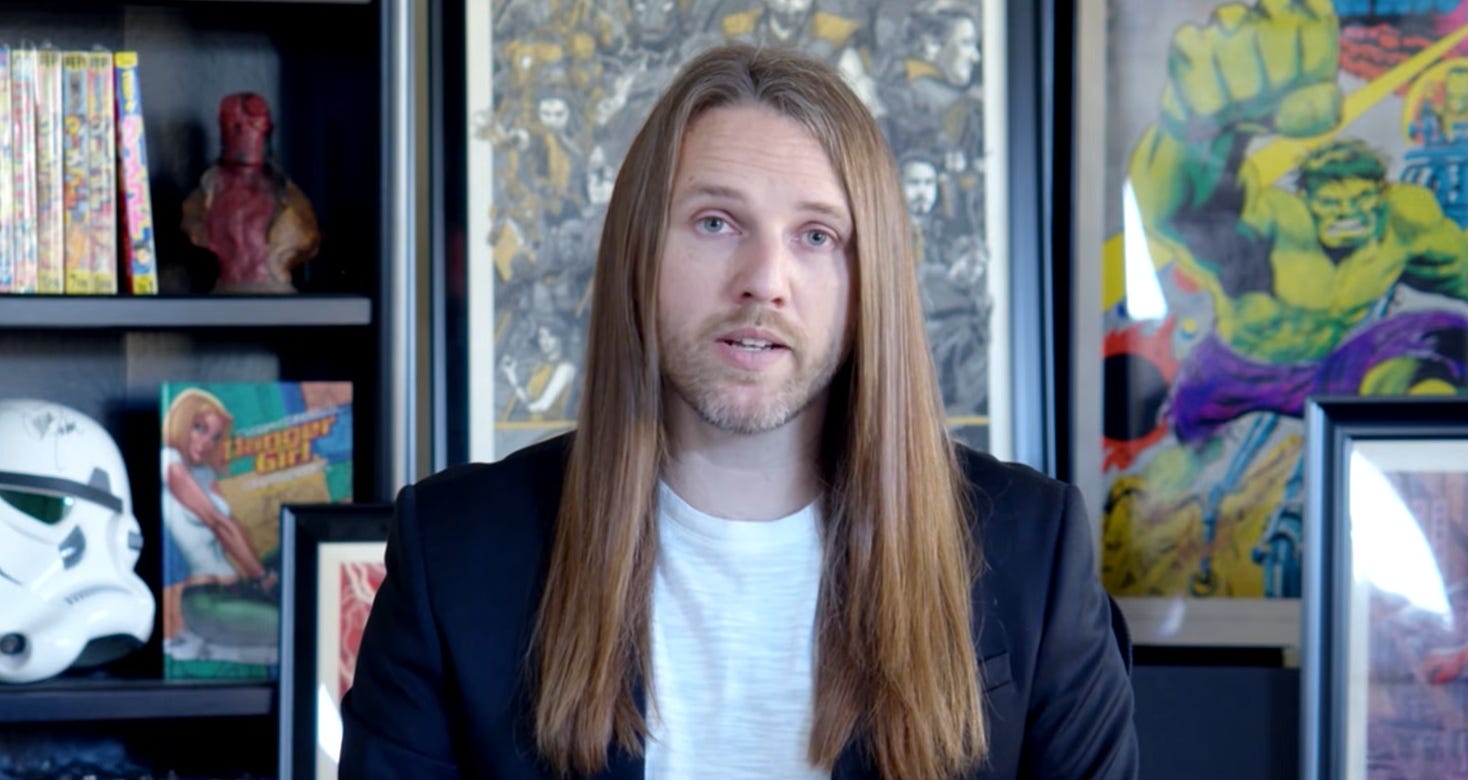
The moment I was done watching Stan Lee: The Final Chapter, I knew I wanted to talk to the director. Jon Bolerjack gave me the closest look I’d seen behind the hype of Stan Lee, to the extent that he could be separated from the hype, and left me with many questions.
When I talk to others about the movie, or even look on the Internet elsewhere, it’s clear he’s perceived more controversially. Stan Lee had many faithful fans, and some see the movie itself as another cash-in on Lee’s image. Only after our interview did Bolerjack’s publicist remind him to clarify something — he was never paid for being part of Lee’s entourage. Conventions would pay for travel and hotel rooms, but the rest was done because he liked being around Lee.
Should he have simply turned his raw footage over to the police? It’s less likely the story would be as well told or known if that had been the case. It’s Bolerjack’s first feature, but he is trained as an editor, and he has whittled down a lot of footage into a coherent story, with at least one wild twist.
I think he’s legit. But you can read on and decide for yourself.
LYT: So why don’t we start by talking a little bit about your filmmaking background. I mean, I looked on IMDb like everyone else. It looks like there’s some DVD extras, there’s some visual effects. What is your filmmaking background?
Jon Bolerjack: Yeah, so I went to film school for editing, actually. And when I got out of film school, I went. A friend of mine got me a job working in documentary for Robert Kenner. He’s the guy who did Food, Inc. So that’s where I kind of cut my teeth on, which is doing assistant editing, grunt work, moving files, that kind of thing. And then I left that job for an even more boring job of doing data management.
So it’s all very detail-oriented, keeping track of stuff. And then that company did DVD extras, back when people bought DVDs. So I stayed at that company, and over time worked my way out of the data department into more of a producing [role] where you go on movie sets and you film all the behind-the-scenes stuff and then make the documentary.
So that’s the majority of what you see, is that kind of behind-the-scenes stuff. And then I realized while I was there, because I’m always just trying to be as observant as possible, that they didn’t have a graphics department. We were paying other companies in LA a lot of money to do it.
And I was like, why don’t we just do that here and save the money? And so we started a graphics department and I eventually started working as the head of the graphics department. So that’s just kind of how I climbed the ranks there.
So that was all my film experience before Stan Lee.
LYT: I think your film’s about the right length. I want to be clear before I say the next thing, which is I feel there are a couple of moments that are a bit condensed and I’d like to expand on them.
JB: To be clear, you’re not wrong. My movie was three hours long. We had to cut it down.
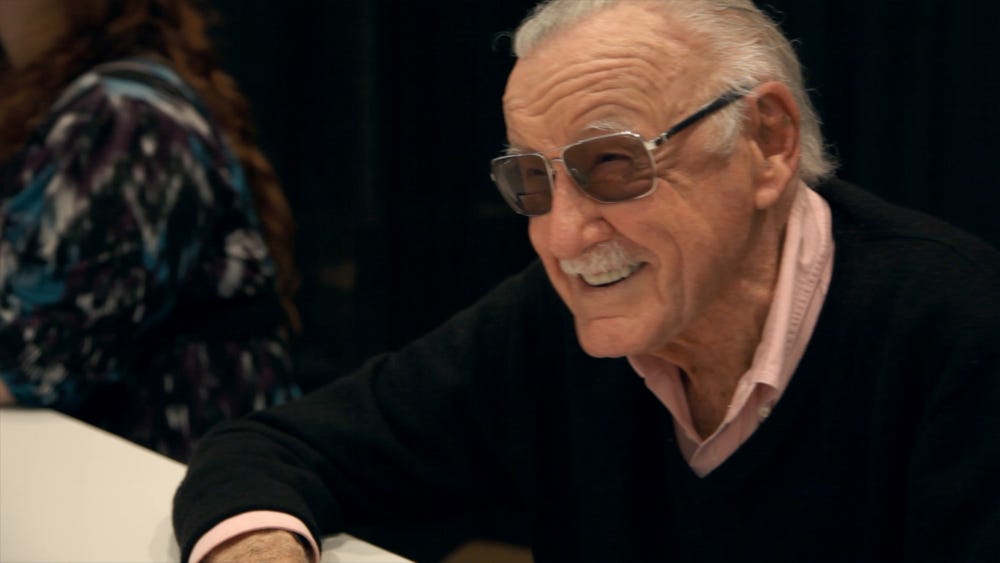
LYT: So take me through, you get to meet Stan Lee and then you’re hired on as the entourage. What was the process like?
What’s the vetting process? Obviously his vetting process is slightly shaky. as your film evidences. But what was it like for you?
JB: Everything is always very tentative. You sort of see Stan and then you’re like, OK, cool, when’s the next show? And then you’re just there, you’re not.
There’s really no official list of who’s there. It’s kind of as needed. I just had the luxury of being close to Stan. Like I said, there’s no job. There’s no working for a paycheck. You’re just sort of there, or you’re not. So sometimes if a guy lives in New York, they just use him because he’s there. He comes in and hangs out.
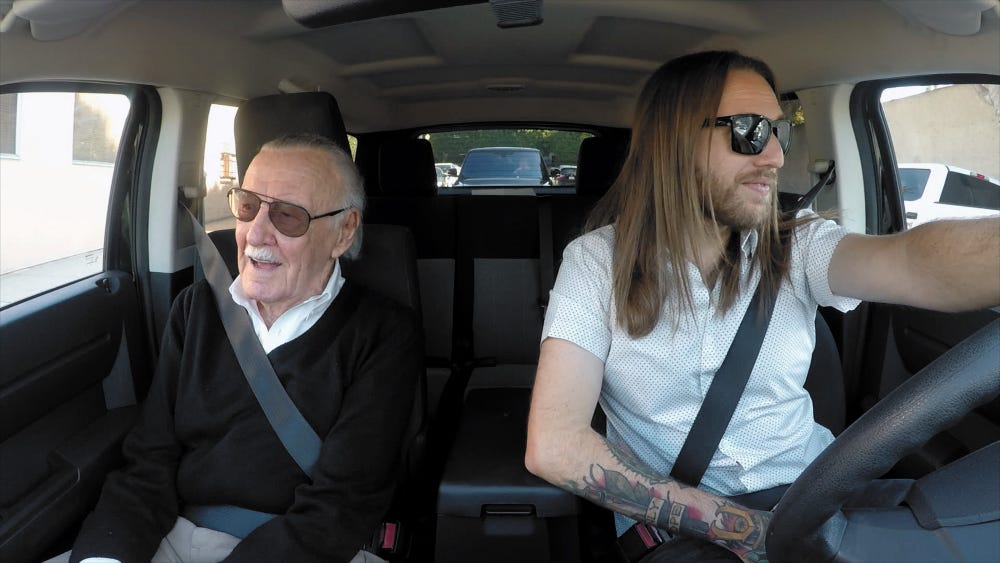
So I had the luxury of just being with Stan. So if Stan wants to be there, then I’m there. When he would do a convention, they’d be like, ‘OK, but Hairspray’s got to come with me.’ [“Hairspray” was his nickname for Jon.]
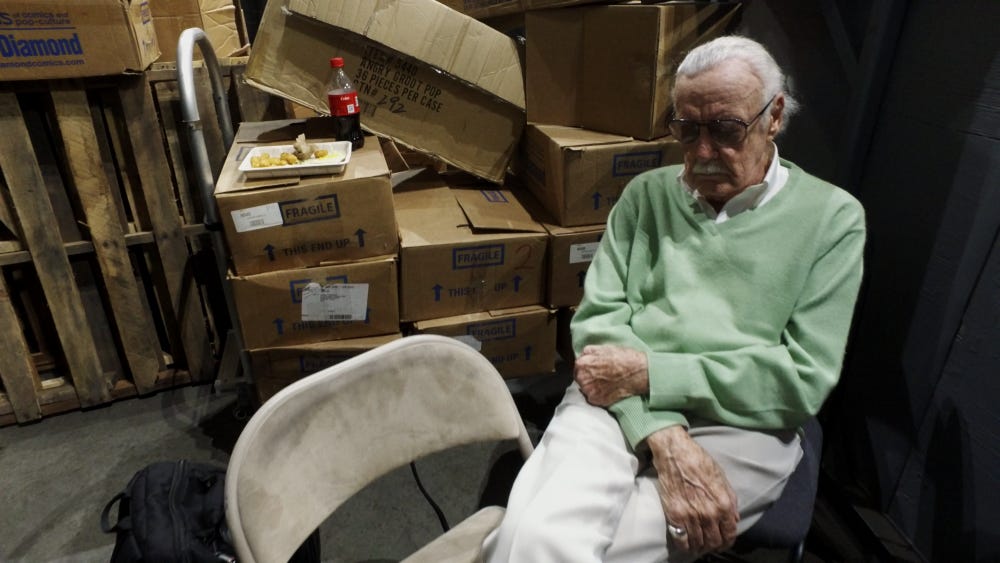
So that was really cool, because I didn’t have to worry about it as much as other people. Would they be in or out of the thing? So that’s really what happens. You get that comfortability with Stan. As you see in the film, Stan’s getting shuffled around A to B. And sometimes he’s just sitting there by himself, so now I’m there to keep him company and talk to him. And I think he appreciated that.
LYT: I assume the original plan wasn’t to document elder abuse. You’re just documenting your trips. What was the original plan and then how does it change once you see all the dailies, and once you get fired.
JB: So first, the thing is, as someone who’s not a cop, obviously, or a detective or a lawyer or anything: elder abuse is such a vague expression. It could be immoral but not illegal.
And that’s actually kind of like in the film. We don’t even really give it any sort of official name, because it’s more about you looking at it and knowing that something is wrong without even having to meet some sort of legal technical word for it. You just know it’s wrong and that’s actually what’s important.
But no, when I started filming, it was actually just going to be something really boring, probably. Just a little day in the life of Stan. He goes and meets a celebrity, and when I got there, that’s when he realized, no, no, he’s just signing a bunch of stuff. He’s signing stuff in the morning. He’s signing stuff at night. It’s not particularly that interesting. So eventually I just got with Stan and said, look, can I just hang around? I’ll film something and eventually a story will present itself.
And I didn’t know what that story was, but then the story presented itself. And then you go back and that’s when you start seeing patterns that you may have missed or nuances that you didn’t notice at the time. And then you go back and find all that stuff.
LYT: One of the things that surprised me the most is, as an observer from the outside, I’ve seen Stan Lee for years and he’s got this kind of cheesy pitchman spiel, the “Hi. True Believers!” And I was sort of waiting in the documentary to see, when does that turn off? And it seems like it never does. Is that the case?
JB: I mean, it definitely…everything that you do is like a projection of an inner self. So of course he would turn it up to 11 when he would be out there, but that comes from a place that’s real. You know, you can’t, you know, he’s not that good of an actor.
His cameos might’ve been funny, but no one would call Stan a master actor. He was just who he was and that was, you know, and that was him. So yeah, I know it was like that underneath.
I mean, he would say things sometimes like he’d go, you know, “I said ‘true believers.’ It sounds great, but what are we believing exactly? What is the truth that we’re believing?”
You know, he was self-aware for that, but yeah, it was always on, you know, it was him.
LYT: Did you ever see him without the wig?
JB: No, so, okay, so here’s the deal, right? So he had a wig because you see the old photos of Stan.
He’s bald. He’s like 30 and he’s bald. And now he’s got an old thing of hair. So the funny part about that is he did have a wig back in the day, in the ‘60s, 70s, whatever it was. And I’ve talked to some of his old secretaries and they said that he would forget his wig some days. So some days he wouldn’t have it, some days he wouldn’t have it. And the secretaries would say, ‘Listen, you got to pick a lane here, either have it or don’t, because this is freaking me out,’ like back and forth.
So he eventually did get really early hair transplant surgery when it was like very cutting edge. And to his credit, that held. You wouldn’t think, you know, it would hold, but you could see in photos too, he’s got like a scar on his forehead and you can see where it was. But yeah, so I never saw him. I only had him post-hair. I never saw the wig.
LYT: The other thing is we think of Stan as a great businessman. He’s obviously built himself into an icon. You have so many tales of people saying, well, he got the lion’s share of the money, I got screwed out of it. How is it that he doesn’t know what he’s making? How is it that he just hands it over to a bunch of random people at this stage of his life?
JB: Look, I don’t know if this is a hot take because it’s based in reality, but it might be it’s a hot take because it’s not especially well known. But to be clear, like, dude, I love Stan. He was a great guy.
He was not a good businessman. Like, everyone wants that because that’s a projection. Because like you said, he’s really full of bravado and he’s the center of attention. But Stan in the film, he documents his bad business dealing. He made that bad deal for the rights. And if you go through Stan, I mean, I can make 10 more movies about other business.
Just wiki him and you will see it is just in the ‘90s with the stanlee.com or whatever. Like. you’ll see the bad business decisions that come with that stuff. And he was just overly trusting and overly self-assured. Someone would tell him, we’re going to make a million dollars. And he goes, ‘Yeah, we’re going to make a million dollars.’ And that was, he signed off on the thing.
So he wasn’t in himself a great businessman; that’s not to say that other people also did not get short of the sticks or anything. But, you know, he was not worth what people think he was worth. And he did not retain the rights, the things people thought that he did. Even me as a kid when I met Stan, I thought, oh, this guy owns Marvel. This guy, you know, he never owned it. He just worked for them. That was sort of the name of the game.
LYT: I notice obviously his daughter is not on camera anywhere. So I assume she didn’t cite any clearances. Is there anything you can say about why she wasn’t involved and why she wasn’t involved in his dealings and protecting him a little more?
JB: So the thing which I have sort of told the people is that, you know, Stan is in the film fighting his own battle. There’s a lot of things happening to him now. J.C., the daughter, she has inherited, in a way that her father did, to have sort of people that are not, let’s just say, less than scrupulous around her. So when you’re, you know, remember Stan is 90 and his daughter is 60. So when you’re 60 and you’re fighting somewhat similar things, you don’t have time to keep your eye on the ball, you know what I mean?
And Stan’s still the dad, you know, and she’s still the daughter. And, again, you see in the film as well that sometimes from the outside things might look fine, you know. There is some money coming in. It’s still a decent amount. You don’t know how much is. She’s not at the convention. She doesn’t know how much is really missing. So there’s a catch-up to be played there about, like, what’s really happening. And if Stan doesn’t know how much money he made and he’s there, it’s going to be hard for her to know how much money he’s making.
She’s not there to know. So it’s a really complex family dynamic. But that is also the point of the movie is, like, you’ve got to pay attention. So that’s just part of the story, you know, to be paying attention to what your family is, what’s happening.
LYT: Did she decline to be involved with the film?
JB: No, so I know JC. Like, we’ve had conversations. I spent a lot of time with her.
You know, she was there, you know, with me when I was there all the time at the end of, you know, Stan’s life. And it really can be very traumatizing. There’s people in the movie. One of the guys in the film who gets very emotional, he has not seen the movie. And he’s, like, a very important piece of it, because to go back to that time is actually really painful for him. And he is not going to see it until he can really kind of get his head around it.
As the daughter, you know, there are times that she had tried to make noise about it and alert people to what she thought was going on. But her stuff generally went unanswered or they didn’t believe her or things were pivoted in a light that made her seem not reliable. And so for her, she’s going to have that same sort of reaction. For me, it’s Stan. For you, it’s, you know, Stan Lee. For her, it’s her father. So that’s, like, a very hard thing to ask someone to step into. And I think the film works without having to sort of re-up those emotional things for her. And I think it still answers all the questions.
I think it validates a lot of her claims. And I think it was better for her to not put her through that if I didn’t have to. And I know Stan wouldn’t want that if it wasn’t necessary. I think that’s the longer way to explain.
LYT: Was it tough to get the body cam footage from the LAPD?
JB: Getting body cam footage, I will say this. Getting body cam footage is almost impossible with the LAPD. And they delete it after, like, five years or they don’t hold on to it.
But, yeah, I mean, L.A. needs to fix their potholes and their body cam footage requests because that was quite, like, a thing to get. So, yeah, it was not easy. If this happened in Florida, I would have had seven angles. But L.A. makes it very hard.
LYT: The other area of the film that I feel is very condensed and I’d like to expand upon, but you may not be privy to it because I think you were let go, but it’s after the first crooked head of security goes, get rid of the crooked ex-con with the mysterious identical twin, which is a hilarious twist that you couldn’t make up, and then immediately replace him with, like, a starfucker, for lack of a better word.
How does that happen? How does nobody say, okay, we got rid of the crooked guy. Let’s be on the lookout and make sure we don’t hire another crooked guy and immediately do that?
JB: So I know the way that it happened, but the problem is the reason it’s not in the film is I need corroboration. I can’t take one person’s word for it. I need more than one person to sort of talk about it.
So, you know, there is a story there, but I will just say that it just really just boils down to right place, right time. I mean, Keya had been in Stan’s ear for a long time, and it just happened to be at the right place at the right time, you know. If some guy walked by and he dropped a million dollars and you picked it up, it wouldn’t be because you were a skilled, you know, money finder.
You just happened to be there when the money fell out, and that’s really what happened. It was just pure luck. If it had happened 10 hours later, it might not have happened that way. It just was right place, right time.
LYT: You sort of make a note in the film that all these other celebrities at cons have guys in suits as entourage, and Stan kind of has misfits. Is that a conscious choice by him that he wants sort of, you know, a motley crew who look like fans as opposed to like...
JB: From a filmmaking arc standpoint, that would be great if that was a conscious choice. I just think that thing more happened. It sort of led from the top down, I think.
I think that’s just kind of how that formulated itself.
LYT: I’m sure you know, if you put the name of this movie into Google, you bring up Reddit threads, and there are people I’ve talked to about this movie who immediately kind of bristled. They were like, ‘Well, was that guy part of the problem? Why didn’t, you know, how is he not doing the same thing by cashing in on this?’
So I know you’ve seen all of that, and they’ve said, you know, the Kickstarter didn’t give people a copy of the movie. I want to give you time to just address all of that.
JB: I mean, look, I want to do two things, right? One, and this is going to sound more overly political than it actually is because Stacey, my publicist, will just know that it’s not me, but the thing is, is like the Reddit stuff and just the negative aspects of the film, it’s really hard to take seriously in a real way when you haven’t seen something, right? Like if I just said right now, you know, if you said, tell me about my mom, and I’m like, your mom’s deal, like how would I know that, right?
Like if I told you, you know, your mom’s terrible. She’s the sweetest lady ever. It’s going to actually not really mean that much to you because what do I know?
I don’t know your mom, you know? So it’s like when someone’s on the Internet just yelling into a vacuum that they’re upset about something, first of all, one, they don’t have the information, and two, like you sometimes got to try your best to cut people slack when they don’t know because like that’s just our nature, right? You see something on Instagram, you immediately go, that guy sucks because you see this 10-second clip of something. That’s just what we are bred to do now. So, you know, that’s just part of – that’s just Reddit also. Like Reddit is just the – it survives on that, okay?
So you have to have that. So there’s that. And, you know, to your point, again, it’s like if people go, well, could he have done something? Well, then go see the movie, and then that should answer those questions. Now you can’t keep everyone happy. Some people are going to see it, and they’re not going to like it. They’ll come in with an agenda, and they’ll see what they want to see. But, like, what are we going to do about that?
You know, like I can’t hang on all that kind of stuff. So, you know, people – I think if people come in with a real honest, open mind and watch it, I think that they will – it will be much more complicated. If they leave the film and at least feel it’s more complicated, then I will take it on a win. But if someone just comes in and black-and-whites it, it’s like then what are you going to do? You know what I mean? You can’t really – you can’t change that.
LYT: So why not offer a copy of the movie as one of the Kickstarter perks?
JB: Oh, that actually – no, thank you for getting me back on track.
So here’s – that’s actually something that I think is an interesting sort of thing. So I think, to be clear, right, when someone does like a GoFundMe or a Kickstarter, right, a lot of the times, like, it’s like we’re still making the movie. We don’t know when the movie is going to be done.
We don’t know that if we make the movie and say Netflix wants to buy it, if we have – if we’re legally obligated to give copies of the movie, then it’s possible that then we can’t stream it somewhere, right? So we want to make sure that as many people see it as possible. And if we shoot ourselves in the foot by making the movie and then it never gets out to the world in a big way because we have promised a thousand people or whatever a copy, it’s actually harming the ability to get it out there, right?
So we didn’t want to shoot ourselves in the foot, get the money, and then not be able to show it to anyone because we’ve, you know, ruined that thing. And secondarily to that, we could have just done like a GoFundMe, and I could have played a violin music thing and said, I’m so sad, give me money for nothing. But I don’t want money for nothing.
You work for your money, right? So I’m trying to offer – I mean, frankly, like, I was going to go to Baltimore. If ten people did it, I would go there and tell them about the movie and show it to them because I want to give them something for their money.
I didn’t want to just ask for free money. But, you know, like I said, the criticism is like, oh, he won’t give us a copy of the movie. And it’s like, no, I’m trying to make sure everyone sees this movie.I can’t, you know. So I wanted to give them something, and I thought, well, I will screen it. I’ll talk to them all night. I will answer all their questions. Like I wanted to give my time as a thank you for their money because I don’t like just asking for money. Give me money, you get nothing, you know, it’s like it’s not in my nature, so I wanted to do that. And that’s actually – you know, that was part of the misconception of the Kickstarter. You know, some people saw it how they wanted to see it.
But again, we got there, and we actually got – some people contacted us outside because of that publicity, and that helped with crowdfunding that actually one of the guys in the movie came to us after that and said, dude, do you want me to do an interview? And I was like, oh, my God, I’m looking for you. I couldn’t find you. This is spectacular. So the price of Reddit was worth what we got out of the attention. So it was definitely like a worthwhile tradeoff.
LYT: Okay. So it’s coming out on digital, I believe, the 28th. Are there going to be regional screenings for Kickstarter people or for not Kickstarter people? Is there going to be anything besides the digital?
JB: So to be clear, if you just e-mail me, and I will show up to your house with a TV, and I will play it for you. No, I just – I wanted as many places as possible. So, like, we’re talking to some other film festivals right now.
We’re talking to some other places that could possibly screen it. I mean, the easiest way will to – you know, on the July 28th, it will be on, like, Apple TV and Amazon and Fandango and YouTube and, you know, everywhere. But I just wanted as many places to see it.
And that’s my job is to make sure that everyone gets a chance to see it everywhere. And I’m just going to do my best to get that out there.
LYT: I know I’m going over my time, so I just wanted to add two quick ones at the end. One, what is next for you as a filmmaker? And two, what brand of hairspray do you use?
JB: So I’ll do a reverse order. Unfortunately, to Stan’s name, I don’t actually use hairspray. But when Stan gives you a nickname, you take it. You don’t sit there and squabble over that. And what’s next for me is I’m still – the problem is, is when I get laser-focused on something, I just laser-focus on that. So I can’t even let my eye drift to my next real thing until this is, like, firmly done.
And we’re in the home stretch. So as soon as that goes, I’m looking at some stuff in Japan I may be working on. But right now I’ve got to finish out this Stan thing, make sure it’s done, and then I can move on.
LYT: Do you still do any of the other stuff, like the comic book store or DVD extras or anything like that?
JB: No, I get contacted every once in a while to do some, like, freelance work here and there. But, you know, after you do that for a while, it’s very easy to burn out of meetings and all kinds of stuff. So I don’t do that too much anymore.
Prefer not to subscribe via Substack? You can leave a tip through Buy Me a Coffee instead.
You can also do PayPal.